Stop spending hours on routing, monitoring, and chasing updates. Jovis handles coordination work autonomously so your team can focus on what actually matters.
The real work gets buried under coordination overhead
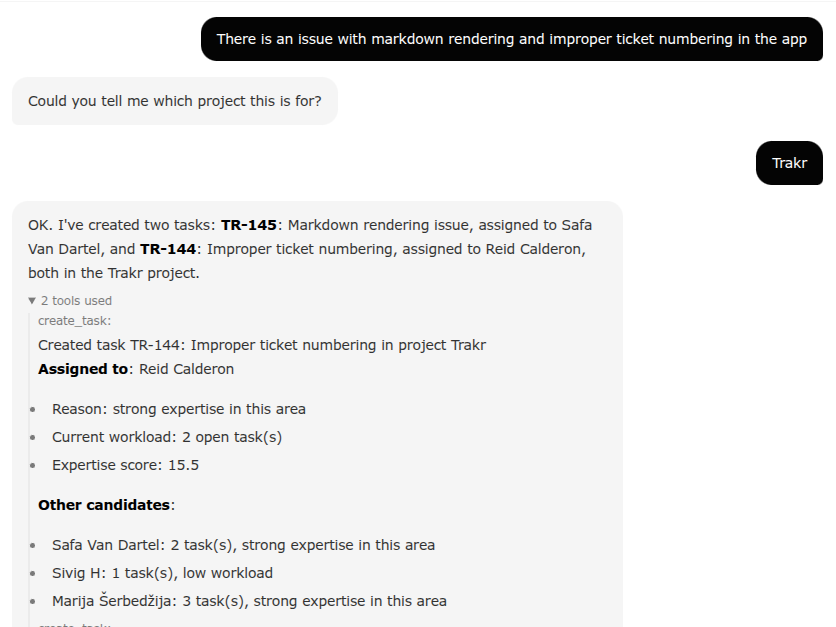
Someone manually triages every bug report to figure out who should own it
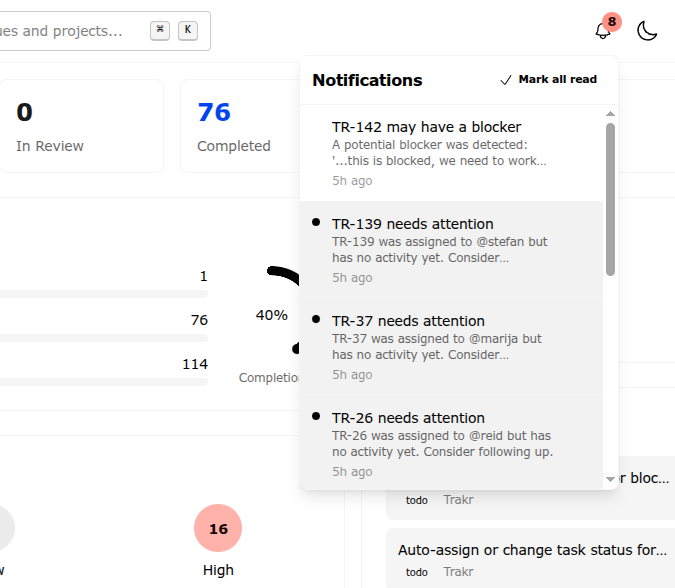
Managers discover blocked tasks only when someone escalates
Engineers wait for answers from people who don't know they're waiting
Two teams build overlapping solutions without realizing until it's too late
Current tools don't solve this. They're databases with dashboards. Humans still do all the routing, monitoring, chasing, and connecting.
Not an assistant that helps you use a tool. An agent that actually routes work, monitors progress, spots blockers, connects related efforts, and nudges people before things fall through the cracks.
"A chief of staff for your engineering team that never sleeps, never forgets, and scales across every project."
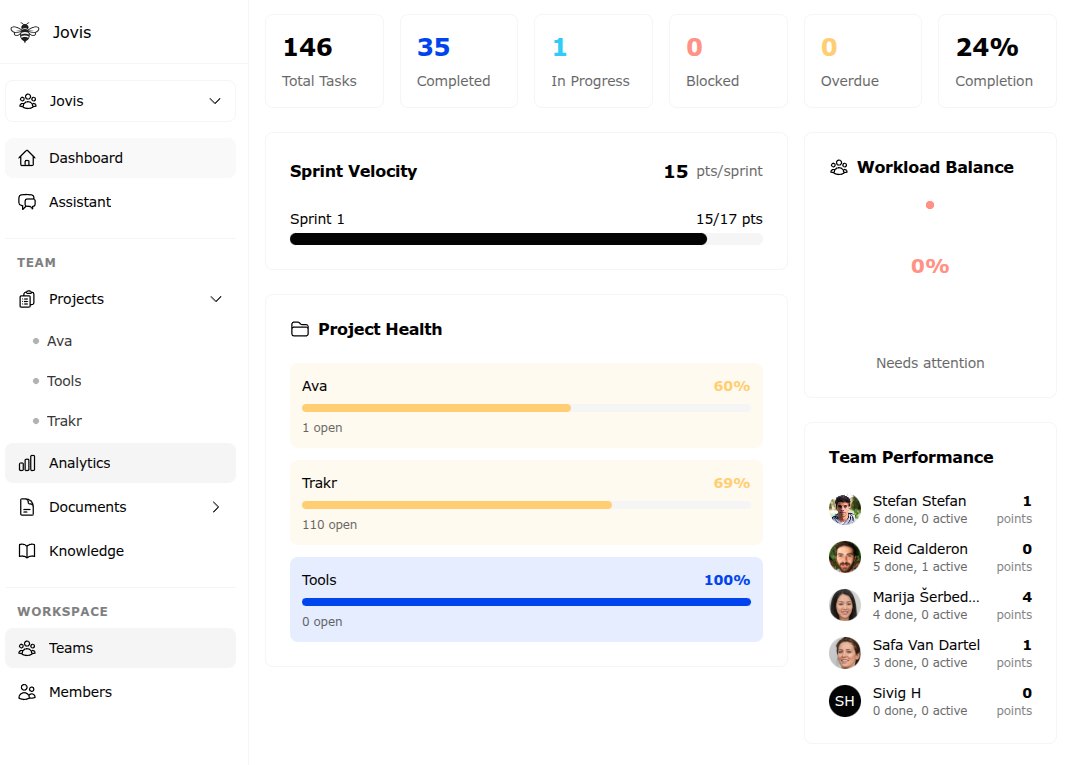
Work enters from any source - email, Slack, form, API. The agent classifies urgency, identifies the right owner based on context (not static rules), decomposes into subtasks if needed, and sets realistic timelines from learned patterns.
The agent monitors for blockers before they become critical. It detects stalled work, investigates why, flags overcommitted teams, and escalates when human judgment is needed.
As work progresses, the agent identifies cross-team dependencies, creates coordination tasks automatically, tracks blockers, and nudges owners before items hit the critical path.
Connect your existing tools - GitHub, Slack, Jira - and the agent learns your team's structure, ownership, and patterns. Gets better the longer you use it.
| Traditional Tools | AI-Augmented Tools | Jovis | |
|---|---|---|---|
| Coordination | Humans coordinate | AI helps humans coordinate faster | AI coordinates, humans execute |
| Workflows | Static workflows | Workflows with AI shortcuts | Dynamic, learned workflows |
| Monitoring | Reactive | Reactive with suggestions | Proactive monitoring |
| Approach | Tool-centric | Tool-centric with AI help | Intent-centric |
"We used to spend our Monday standups just figuring out who was blocked and why. Now Jovis surfaces all that before we even meet. My team recovered 6 hours a week that was pure coordination overhead."
"The blocker detection alone paid for itself. Last month, Jovis caught a dependency issue between two teams 3 days before it would have derailed our release. That kind of visibility was impossible before."
"Bug triage used to eat 2 hours of my day. Now incoming issues get routed to the right engineer automatically based on code ownership. I actually get to write code again instead of playing traffic cop."
Their AI features help you write better descriptions or summarize threads, but the model stays the same: humans coordinate, tools store. Jovis actually does the coordination - routing, monitoring, nudging, dependency tracking - the stuff that currently lives in your head, your Slack DMs, and your Monday morning syncs.
You control it. Low-priority items can be handled without human approval. High-priority actions require confirmation. The threshold is configurable, and you can see the agent's reasoning for every decision.
The agent learns from corrections. Reassign a task it routed incorrectly, and it updates its model. Override a priority classification, and it calibrates. The system is designed to get better the longer you use it.
GitHub, Slack, Jira, Linear, and more. The agent needs context to work well, so we connect to your existing tools and learn your team's structure, ownership, and patterns.
Initial connection takes minutes. The agent then takes a couple of weeks to calibrate and learn your team's patterns. After that, it gets better the longer you use it.
Incident management works well - high urgency, clear before-and-after. Run it for two sprints. Measure how much time your team gets back.
If it doesn't save at least 5 hours per engineer per week, walk away.